
Is Just War Theory Outdated?
Wrestling with my ethic of war and peace

As my summer course on World War I wraps up this week, my students used the last of their weekly essays to draw on what they’ve learned about that particular conflict to “articulate a personal understanding of the ethics of war- and peacemaking, as informed by your faith.”
To help get them started, I recorded a forty-minute video walking students through some possible issues to consider and summarized the classic Christian traditions of pacifism, holy war, and just war. I pointed to examples of each from the history of WWI, laid out some larger theological and ethical arguments for and against each position, and, more broadly, acknowledged why it can be so hard for those who follow the Prince of Peace to take a consistent position on something as complex as war.
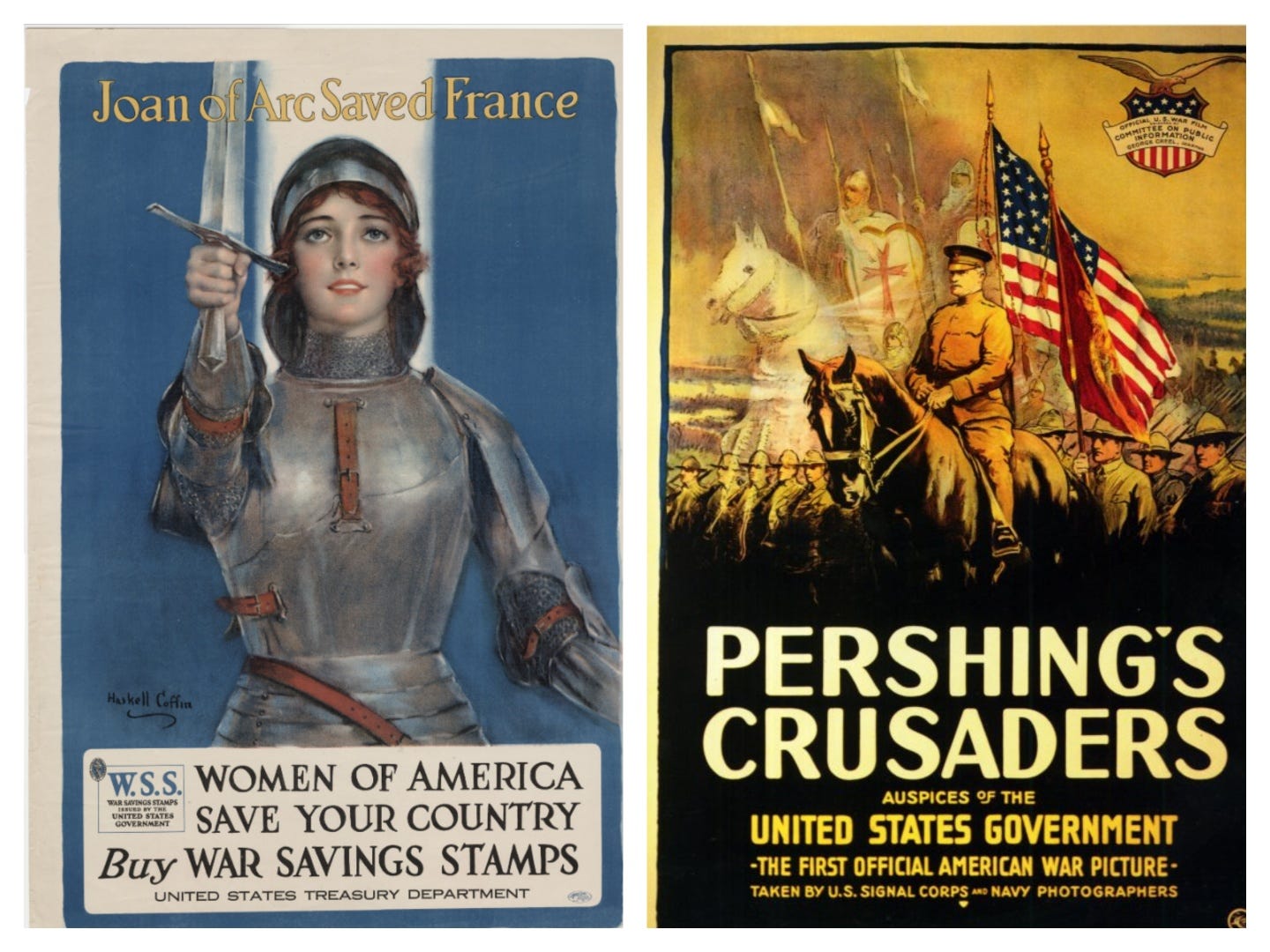
I did not, however, articulate for them my own ethic of war and peace, since I never want to read students simply parroting my opinions. But since they’ve now turned in their essays, I thought I’d celebrate this last day of our class by using Substack to work through some of my own views on war and peace.
If I had to summarize my complicated, uncertain position here, I’d say that I’m an unhappy adherent of just war theory.
First and foremost, I have zero personal affinity for the holy war tradition. Even if I could be convinced that the Old Testament teaches that God might continue to mandate mass killing as a righteous activity for his covenant people, I don’t see how that view can survive contact with God made visible in the life, death, and resurrection of Jesus Christ, who made a new covenant in the blood he poured out on the Cross. If followers of Jesus may need to take up their cross, then they should be ready to die for his sake, but not kill for it.
So instinctively, I’m drawn to Christian pacifism, as embodying an ethic of love and self-sacrifice that closely resembles the costly witness of Jesus and his first followers. I admire, for example, Mennonite scholar Harold Bender’s “Anabaptist Vision” of a voluntary church so committed to discipleship that it would rather suffer than participate in any “existing social order which is contrary to the spirit and teaching of Christ and the apostolic practice.”
Yet I personally affirm what Bender described as the Lutheran position, “that since the Christian must live in a world order that remains sinful, he must make a compromise with it.” I can never quite agree with pacifists like the American Quakers who argued during WWI that “no plea of necessity or policy, however urgent or peculiar, can avail to release either individuals or nations from the paramount allegiance which they owe to Him who hath said, ‘Love your enemies’ (Matt. 5:44, Luke 6:27).”
.jpg)
I would first draw a distinction between what’s required of nations and individuals. I’d never expect any person to contravene his or her own conscience on account of “necessity or policy.” Even if Bender is right that I leave myself no choice but to “seek forgiveness by the grace of God” for my “participation in the evil of the world,” I want countries like this one to protect the right of Mennonites, Quakers, and other pacifists (religious or not) to refrain from killing during wartime.
But to the arguable extent that “nations” — or, rather, the states that govern such people-groups — do indeed owe “paramount allegiance” to Christ and his law, then sometimes we have to acknowledge that one Christian law of love can contradict another. In a world of enduring sin and tragedy, the enemies we’re called to love can still threaten the neighbors we’re called to love (Matt 25:39, Luke 10:27). That tensions doesn’t make war holy or righteous, but it does sometimes make such violence necessary.
My view here aligns me with WWII-era Christian realists like William Temple, Archbishop of Canterbury from 1942 to 1944. As Australian scholar Michael Bird explained in a recent Substack post, Temple did not doubt that war “is a monstrous evil” that Christians should strive to abolish, yet he ultimately believed
that states bear a moral responsibility to restrain evil, and that war, while always a tragic evil, could be a lesser evil than allowing aggression or injustice to go unchecked. He insisted that Christian ethics must engage political realities rather than retreat into the luxury of an idealism disconnected from the travesties and tragedies of the real world.
But even the “lesser evil” of war is what is necessary, it must be tempered by an abiding commitment to what is right. In the early days of WWII, another Anglican bishop, George Bell, warned that
…the moral law is both super-national and supernatural as the Gospel is. The Church then ought to declare both in peace-time and war-time, that there are certain basic principles which can and should be standards of both international and social order and conduct…. The Church therefore ought to declare what is just. It has a right to prophesy, to analyse the issues which lie behind a particular conflict, and to rebuke the aggressor…. the Church must guard and maintain those moral principles in the war itself. It must not hesitate, if occasion arises, to condemn the infliction of reprisals, or the bombing of civilian populations, by the military forces of its own nation.
Which is why Christians like me have most often fallen back, however unhappily, on just war theory, at least as a guide for the behavior of states. While killing is a sin, war can sometimes be necessary, so long as it meets certain conditions — both in the decision to go to war and in the waging of war itself — that make war rare in occurrence, limited in scope, and conducive to the restoration of peace.
